During my 6 months, I travelled far and wide throughout the country. There are many more places I’d like to go, and I’d like to go back to many places during a different season. Here are my thoughts and tips for the ones I have been to.
Included in the below are:
- Kyoto
- Kanazawa
- Hiroshima
- Naoshima
- Himeji
- Okayama
- Naruko Onsen Town (and Matsushima)
- Hokkaido (Rishiri and Sapporo)

Kyoto
Old-school Kyoto, nestled among green hills, is a fascinating place to visit. Expect temples and matcha tea in profusion.
One temple which offers something a little different, and rather wonderful, is the Saihoji moss temple. On arrival at the grounds you make your way to the prayer hall and write out sutra. Then you wander round the sprawling moss gardens under dappled sunlight, accompanied by the trills of numerous little streams and the splashes of the fish in the pond.
Booking is slightly unusual. The temple is run by Zen Buddhist monks, and so visitors are encouraged to book using a special kind of Japanese return postcard in order that they slow down and enjoy even the mundanity of the application process. Most likely if you’re coming from abroad there isn’t time for that, so you can also book through the (Japanese version of the) website.
Arashiyama, not far from Saihoji moss temple, is much more than just a bamboo forest. The setting on the river is beautiful, and there are quirky places to visit such as the Miffy Bakery, which makes a variety of extremely kawaii (かわいい or ‘cute’) things.
Other things that might be near the top of your Kyoto bucket list are:
- a visit to a gyukatsu (beef katsu) restaurant, a Kyoto speciality. The cheapest option tends to be quite fatty so it is usually worthwhile going up a notch or two to have the fillet (which won’t be much more).
- to try everything matcha (including beer, if you dare!) Uji is famous. As well as the tea itself, Kyoto also abounds in little shops selling a magnificent variety of matcha flavoured puddings, parfaits and even tiramisu. If you do find the beer, it’s worth knowing there are two types. The first uses matcha in the brewing process. The second, usually more delicious, involves pouring a small jug of fresh matcha into a pint of draft beer.

Kanazawa
Kanazawa is one of Japan’s old Samurai-period towns. I visited during the major festival of the year, Hyakumangoku matsuri (“One million gods festival”), which takes place every year at the start of June. I made a video about it which you can watch on Youtube here.
Notably, Kanazawa is home to the beautiful Kenrokuen gardens – which Monty Don visits twice, once in spring and once in autumn, during his brilliant series on Japanese gardens. Kenrokuen is one of Japan’s three ‘perfect’ gardens, each created during the Edo period (1603–1868) and combining the six features of the ideal garden space. These ‘perfect’ gardens are all strolling gardens (kaiyū style), based around a central pond. This contrasts with zakanshiki gardens, which are designed to be viewed from indoors. You will likely see both types during your travels in Japan, so keep your eyes peeled.
Other top places to visit in Kanazawa include the Gold leaf museum, the Higashi Chaya District (where geisha used to live and you can now find gold-leaf-coated ice cream!) and the ninjadera.

Hiroshima
The sense of history is, inevitably, still strong in Hiroshima. There are also noticeably more foreign tourists than in other cities in Japan. It’s a good idea to stay in downtown, near the Peace Park, as everything is easily walkable from there. When I went, The Knot was a good option.
Okonomiyaki (noodles and cabbage, in a pancake, slathered in delicious sauce and toasted on a teppanyaki hotplate) is a speciality of Hiroshima, and Okonomimura is The Place to have it. It’s four floors of shops all selling exactly the same thing, very deliciously. とても おいしいい! The area around Okonomimura, including the huge covered shopping street (very typical of Japanese cities), is also a fun place to explore.
Miyajima is a popular day trip from Hiroshima. Your choice of whether to get there by tram or boat largely depends on the tides, since you want to be there while the water is high, in order to see the beautiful torii gate at its finest.

Naoshima
The island of Naoshima is a jewel of the Seto Inland Sea, not far from Hiroshima or Himeji (take a bus south from Okayama for an hour to reach the port). Naoshima’s stunning natural features are complemented by a profusion of cool art galleries and installations. Bring plenty of cash.
The main port on Naoshima is called Myanura. There is a good bus network around the island, and you can also rent bicycles (though it’s not really necessary because the bus works so well).
There isn’t a lot of logistical information online, but what you want is the “Naoshima Area Map” (available at: http://www.naoshima.net/) which is a Visitors’ Pamphlet and tells you everything you need to know. Pick up a paper copy when you arrive at the island itself. Get the Japanese version too, as it (and only it) has all the restaurants on the island and, crucially, which day(s?) of the week they’re open!

Himeji
Himeji Castle, built in 1609, is one of Japan’s most prized national treasures. Being the first castle with white, wingtip roofs, it came to be known as the ‘White Heron’ castle.
Visiting Himeji is an easy day trip from Osaka. In fact, because the ShinKanSen is so efficient, nothing in that part of Japan is really very far and you could visit from Kyoto or Hiroshima quite easily.
Before arriving at the castle, have the breakfast set at one of the old-style Japanese coffee shops, such as Hamamoto Coffee. Japan, although historically a tea-drinking culture, has enthusiastically embraced Western coffee-drinking habits and made it its own, developing kissaten (喫茶店) like these. This is an interesting article about the history of Japanese coffee shops.
The tour of Himeji Castle itself, run by volunteers, is really interesting and worth doing because it brings the building to life. Otherwise, like a lot of Japanese castles, you might be slightly left wondering what it’s all about. This is particularly so because, due to the fact that Japanese castles are almost all made of wood, what we visit nowadays tend to be reconstructions of the actual feudal castles. Himeji Castle for instance is currently constructed from about 43% of the original 16th century wood (a remarkably high number) and has been through two major restorations in the past 70 years.
Himeji Castle has lived somewhat of a charmed life, avoiding destruction many times in its 400 year history. It was built after the end of the Sengoku (or ‘Warring States’) period during an extended period of peace. Because of this it had the good fortunate that it was never attacked, as many other castles were. The high quality waterproofing of its roofs has meant the wood has not rotted.
Further, during the Meiji Period in the middle of the 19th century, many feudal castles were knocked down for redevelopment or as a show of solidarity for the new modern Japan. Himeji Castle was bought for just this purpose but, by a stroke if good fortune, the developer, having bought it (for the bargain price of USD 2000) didn’t have the funds to knock it down.
Later, during the intense firebombing of Japan in WWII, Himeji Castle was hit. Extraordinarily, firefighters found the bomb lying unexploded, and were able to remove it with no damage to the castle.
The shrine and gardens next to the castle, east and west respectively, are also lovely little spots to drop in on.
Okayama
Okayama is a typical Japanese city, and probably not worth spending a night in given the other places in this area. That said, if travelling from Naoshima to elsewhere (eg Himeji, Hiroshima, Osaka) you’ll have to go via it to get the ShinKanSen, so you might fancy spending a few hours there.
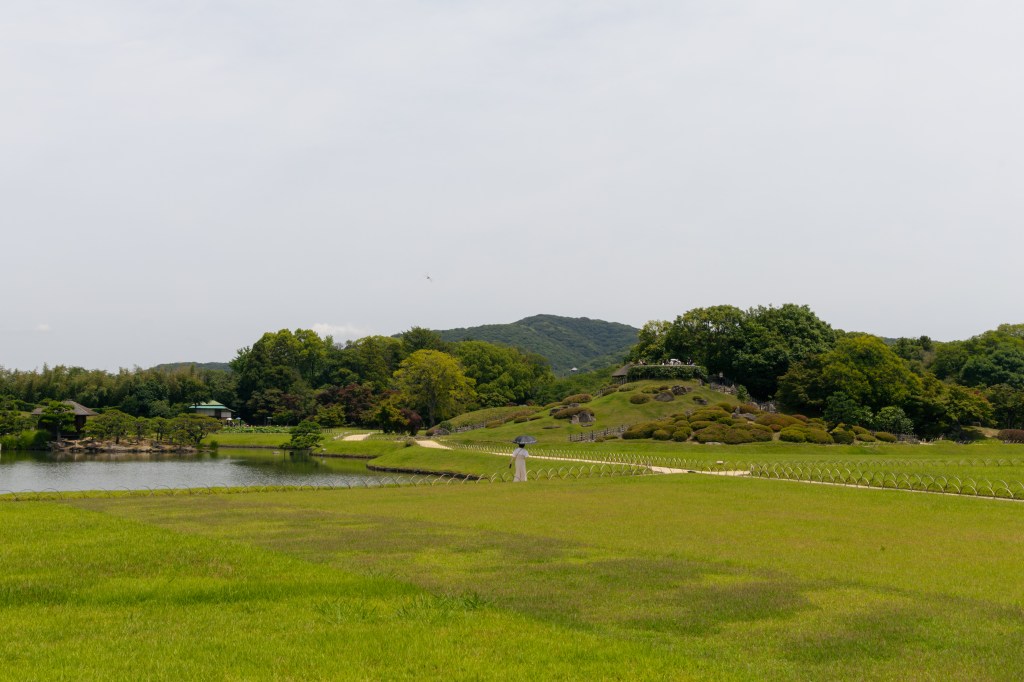
Korakuen gardens are another of Japan’s three ‘perfect’ gardens (see Kenrokuen in Kanazawa , above). They are beautiful, tranquil and quite interestingly distinctive. If you’re minded to visit the gardens, your best plan is to drop your bags in one of the lockers at the station and march out into the streets.
Okayama is also the hometown of Momotaro, or Peach Boy, so look out for all manner of peach flavoured delicacies while you’re there. The story of Momotaro, available here, is a classic Japanese folktale.
If you are feeling more adventurous, spend a rather amusing few hours going off the beaten track and cycling the Kibiji Plain. Take the train from Okayama to Bizen-Ichinomiya station and rent bikes from the friendly old couple there. Then make the gentle 12 mile cycle past various shrines and rice paddies, to Soja station. From there it’s a 20 minute train back to Okayama station.

Naruko onsen town
Definitely one of the more adventurous trips I made during my 6 months in Japan was to Naruko onsen town.
Hidden away in the middle of nowhere (ShinKanSen for 1.5h to Sendai, then local trains for another 1.5h), this is a trip into ‘The Real Japan’. It’s pretty tricky to get a sense of the place from information on the internet so you slightly have to trust to fate, and go to the visitor information centre when you arrive. They’ll give you all the pamphlets and explanation you need (though note that, like the rest of this area, some Japanese is a real help.)
There are apparently 10 different possible kinds of onsen water, from sulfurous to ferric to bicarbonate. The various baths in Naruko have 8 of them!
There are so many onsen to choose from in this town, both in hotels and ‘public’ baths, and I can’t possibly say that the ones I went to were the ‘best’. See which takes your fancy on the day. There are other places near Sendai, like Akio hot springs, which are slightly more famous.
Matsushima
If you’re visiting Sendai or one of the nearby onsen towns such as Naruko onsen town (see above), it’s worth spending half a day in Matsushima. According to some 14th century monk, the view of the pine tree covered islands is one of the three most beautiful views in Japan – to get the most out of it, I’d suggest doing as most guide books recommend and taking the ferry from Shiogame to Matsushima. The view would look most beautiful, I think, in autumn.
To do: Have some incredibly delicious sushi at Santori Chaya Restaurant, wander over a vermilion bridge to Fukuurajima island and soak up the scenery.
Hokkaido (Rishiri and Sapporo)
Hokkaido, Japan’s North island, has three national parks and a total embarrassment of other natural riches, so it is really a choice of deciding what you want to do most!
I visited in August, so while there was none of the famous powder snow, there were flowers in abundance. I just missed the lavender, so if you want to see sights like a giant Buddha ‘floating’ in a sea of purple lavender, you’d best go in July.
There are 6 (major) airports on Hokkaido, and because it is actually a rather large and essentially tricky place to get around (even by car, which is the most convenient way) I’d suggest flying to the area you want to visit (or planning your whole trip around the most convenient flights, as I did!)
I arrived in Wakkanai airport and hopped on a ferry to Rishiri island. (There is also Rebun island, just to the North, which I didn’t visit). I wouldn’t suggest spending much time in Wakkanai, as there are other (and more exciting) places to see!

Rishiri island
The blustery ferry from Wakkanai to Rishiri (or Rebun) is great fun. One can imagine Russia (less than 4 hours away) popping into view any moment. Unsurprisingly, the regular ferry service from Wakkanai to Korsakov (Sakhalin Oblast, Russia) has, as at the date of writing, been put on hold.
Once on the island the world is your oyster (or scallop, sea urchin or kelp, as the mood takes you). I even had a scrumptious dashi and kombu soft serve. Cycling the 70ish km around the whole island takes about 6 hours (which includes regular breaks). Be warned there is only one place to rent bikes (here) and you can’t reserve beforehand, so be quick off the ferry!
Towards the North and East of the island is a beautifully maintained cycle route, which runs for about 25km. The roads of the island are exceptional throughout, and even though I went in Obon week (August, Japan’s big summer holiday) I hardly saw anyone for the whole day. Be warned the weather can turn on a sixpence, so bring appropriate garb.

Sapporo
My three favourite things in Sapporo were:
- Breakfasting on the freshest of fresh sushi at the fish market.
- Visiting the Sapporo Beer Museum.
- The history is fascinating (did you know that initially beer was 3 times as expensive as sake?), and you can (in the Beer Garden) drink the very delicious and only-at-the-Sapporo-Beer-Museum Five Star beer.
- Depending on how much you like beer, The Hokkaido Brewery (different place), where they actually make Sapporo beer, is also worth visiting. You could, for instance, tie it in with your trip to or from New Chitose Airport.
- Getting stuck into traditional Jingisukan (lamb BBQ) at Daruma. Delicious meat, smoky atmosphere.
 Rupert Swallow
1 thought on “Travels around Japan”